This blog is a place for those who have lost a loved one to share their stories and struggles. I started it as a place for me to share some of the the things I’m experiencing after the loss of my 22-year-old daughter in an auto accident. I encourage others to share their stories of the things they’re dealing with as well because we each have different experiences and can all learn from one another.
If you would like to write something click on “Submit Your Story” in the menu at the top of the page, signup for a free account and then write your story. Stories have to be approved to avoid spam or inappropriate content but as soon as they’re looked at to ensure they’re not something isn’t appropriate they’ll appear on the site. I hope this becomes a useful resource for others who use writing as a release and those looking to hear what others are dealing with.
After losing a child, you have days you expect to be tough and full of tears – birthdays, death anniversaries, holidays and so forth. Then there are days you expect to stroll through as just a normal day, well normal for now anyhow. But sometimes the expected days aren’t as tough as you thought they’d be. You don’t have any major breakdowns, no spells of depression, nothing extremely out of the ordinary other than it’s just not a great day.
You may even wonder what’s wrong with you. Why am I not a wreck today? Is there something wrong with me because I’m not more upset? Am I a bad parent because I’m not a disaster today? Then on a regular, ordinary day you break. The sadness sinks in and the tears flow… for no apparent reason. Nothing triggered it, nothing happened, you didn’t see or do anything to make it happen but it did anyhow.
It makes no sense. That’s when you realize grief doesn’t make sense. It’s not something you can measure, predict or overcome. Grief is now just part of your life and you learn to live with it, not because you want to but because you have no choice.
For me, the unpredictable breakdowns happen more often than predictable ones. It’s easier for me to manage and prepare myself for the predictable days. For some reason the last couple days have been unpredictable ones. I have no idea why but I’ve had a few tearful breakdowns in the last couple of days. There’s nothing I can point to that brought it on, but it’s just been those types of days.
Grief is unpredictable and it makes no sense. You learn pretty quickly that you need to learn to show yourself grace in these moments. You’ve experienced a horrible experience and it has changed you to the very fabric of your being for the rest of your life.
Three years ago today as I sat down in the recliner waiting for my lunch to heat up there was a knock at the door. I go to the door to see two highway patrol officers standing there. They asked if Cassie Reed lived at this address. I told them she didn’t any longer but I was her stepfather and asked what was going on. There were many things running through my mind as they asked if they could come in and talk with me, but none of them even compared to what they said. When they sat down and said “Cassie was killed in a car accident this morning” everything went numb. When I say everything I mean everything, my whole body felt numb, my hearing became muffled, my vision was muted and I could barely speak.
People often say your life can change in an instant, but unless it happens you don’t realize how true it is. Most people never realize that in an instant you can have nothing left but memories. In an instant the child you love can be gone. In an instant you go from planning lunch to planning how to tell your wife, your children and your grandchildren that the person they love is gone. In an instant you go from planning your afternoon work load to planning a funeral.
Three years seems like a long time in some ways and like it was only yesterday in other ways. Your mind plays so many tricks on you after something like this happens. Time blends together and I have split seconds when I think it was all just a bad dream as I think I see or hear her, only to have reality come crashing back down on me again. Then I have times that I feel like I haven’t seen her or heard her laugh in an eternity. The mind is a tricky thing at times.
I’ve learned many things over these past three years:
We are stronger than we think we think we are in many ways, yet weaker than we ever imagined in other ways.
No matter how strong you think you are there are times you will breakdown. You will find yourself uncontrollably sobbing and having no idea why. There are also times you can’t figure out why you aren’t crying or upset about something you just knew would destroy you.
PTSD is real. I always thought PTSD was real for soldiers or emergency personnel but was something “normal” people just used as an excuse. That was until I began experiencing it myself.
The memories you make with your children are far more valuable than anything else in your life. The money it cost to make them means nothing when the memories are all you have left.
I’ve always known being a police officer is a tough job and I’ve always respected those who go into the field. I never thought about how tough death notifications would be. I have incredible respect for the men and women who have to go tell someone their loved one has been killed.
The list of things I’ve learned could go on and on, probably without end, but one of the biggest things I’ve learned is about the role of a father and husband. Leading your family through the loss of a child is, in my opinion, the hardest thing a father and husband will ever have to do.
You must be strong for them even when you don’t think you can.
You have to know the answers to questions you never imagined would be asked.
While being strong you also must teach your children it’s ok to cry, it’s ok to hurt and it’s ok to be angry.
You have to do everything in your power to return your family to a “normal” life in a situation where a “normal” life no longer exists.
You have to know the times to let your family see you cry and the times that you must breakdown alone.
Each parent experiences a unique journey through child loss. Neither is harder and neither is worse, they are just different.
There are tons of places to go and support available for a grieving mother, but grieving fathers don’t have nearly as many options.
One of our most important roles as a father is to protect our family. There is a strong sense of failure when you’re unable to, even when you know it’s not realistic to think you could have protected them.
You can’t punch every person who says something stupid or you’ll spend the rest of your life in prison. People say LOTS of really dumb things to people who have lost a loved one.
In the past three years our lives have changed completely. But there are still times you go right back to the day it happened and start those feelings all over again. The best thing we did was to get help. I don’t think we would be where we are today had we not sought help and found the amazing group of people at Lost and Found Grief Center in Springfield, Mo. If you have lost a loved one, find a group to help you through it. It may be the only thing that keeps you moving forward in a time you don’t want to go anywhere.
Twenty five. That’s how old Cassie would have been today. Instead of celebrating with her normal cookie cake she requested and talking about what is to come in the next year of her life, we are remembering what was and grieving what will never be.
The unrealized grief
There are so many things about grieving the loss of a child that you can never know unless you go through it. One of those things most people never realize is what you are actually grieving. Most people assume you are grieving the loss of your child and the absence they’ve left in your life. This is true, but it’s just one part of the grief. Another big part of the grief, which changes based on your child’s age and where they were in their life, is grieving what will never be.
Cassie was only 22 years old when she passed away. She was just starting to find her path in life. She had found a job she truly loved, helping care for elderly patients in their homes. She was engaged and looking toward a future, a family and a home.
As parents we looked forward to what the future had in store for Cassie as well. We were excited to see her finding her place in this world, to see her mature into an adult and start her life and experience all the joys and happiness that can bring.
A future that will never be
All of that future went away in a moment. One single instance took away not only her life, not only our time with her but also the future and all the things that were to come. All of those things she spoke about and all of the things she was excited about achieving are gone.
We will never get to see our daughter fully grown or see what her life was going to become. I will never get to walk her down the aisle as she begins to build her family. Her mother and I will never get to rush to the hospital to be one of the first people to welcome our new grandchildren into the world. We can never again make her favorite dinners for her or watch the smile on her face when she cuts into her cookie cake for her birthday. We will never get to have a relationship with our daughter as an adult. She will always be 22 years old, she will always be unmarried and she will never be a mother.
We absolutely grieve the time we don’t have with our daughter on a daily basis. Those times of grief are very difficult. Most people don’t realize how hard it is to grieve what will never be. That is a grief of questions that will never be answered. We can look back and wonderful memories with our daughter, laugh about the happy times or the crazy things she would do. We know what the moments feel like without her right now. But, the real unkown is what could have been. That’s the grief that is often overlooked.
It was only fitting to start Cassie’s birthday today in a way she would have loved. We gathered the family and went to the local cafe for breakfast this morning in her honor. She loved breakfast and loved eating at the little cafe in town.
While we grieve what will never be, we can still celebrate what was and honor her memory by doing the things she would have loved. We will always cherish the memories we have, the Cassie we all knew and loved even knowing all the things that will never be.
Not a day goes by when I don’t think about Cassie. Some days however those thoughts turn into a grief spiral. Today was one of those days.
The day started just fine, then I looked at an old video on Facebook and heard her laugh. Anyone who knew Cassie knows exactly what I’m talking about. We called it her “Sponge Bob” laugh. It was unique, loud and contagious and I miss it more than I could have ever imagined.
As I sit here and see the video with that little moment of her laugh at the end, the tears begin to flow. I also begin looking for other videos where I can hear it as well. The spiral has begun. The spiral doesn’t start with me searching out pain, it usually starts with one thought, one picture or one video. Then I move to another, then another and so on. The process continues and I find myself sitting here with tears streaming down my face while I search for more photos, videos or just trying to remember another moment passed.
Before losing my daughter I can remember thinking “why would you do that to yourself” when I would see or hear of people looking through old photos and videos of their loved ones and crying. Part of me still wonders “why would I do this to myself?” Now however I understand it’s not the tears that are being chased, but the memories.
I’m not wanting to cry, I’m wanting to remember. I want to hear her voice again, see her face and listen to her Sponge Bob laugh. The tears are simply a product of the love, a flowing of feelings which can’t be put anywhere else.
When you’ve lost your child, some days you spiral. Most days I can control it. Other days I begin looking at photos and videos, thinking about Cassie and remembering the things I miss most. On those days, I can’t always stop the trip down the rabbit hole. Emotions overwhelm me, tears flow and the spiral begins.
I’m beginning to learn however to not try to stop that spiral. Ride it out, enjoy the memories, welcome the tears and most importantly thank God for the wonderful time we had Cassie in our lives. We will never be the same and she will always be missed. These days get a little farther apart but one thing has not changed… some days I spiral.
Some days it almost seems to be too much. Dealing with death is an exhausting, draining and debilitating ordeal. Trying to be strong, to persevere, to keep life on track becomes a full-time job and some days you feel like you’re failing.
After the death of my daughter Cassie, I’ve had many days I struggle just to keep going. This doesn’t even include the struggle to try to appear “normal” and “ok” to everyone you encounter. That’s another full-time job on top of trying to just keep going. Then there are days that I can’t do either one.
I can’t appear ok, no matter how much I want to. I wish I could because it’s much easier to fight that battle than to keep myself from having a breakdown when others notice that I’m not ok today. I can feel it in my heart, I can feel it in my mind and I can feel it on my face. There is no way to hide it on days like this.
I’m tired of dealing with death. Maybe it sounds selfish, but I really wish I could have days that I just deal with me and what I want to do but those never come. Even when I’m not concerned with friends or others in my family, I still have the constant cloud of death hovering above me.
Every situation has the shadow of death dimming the light, no matter how bright it could be. The happiest of times become tainted with a cast of gray and the darkest of times become even darker. There’s no escaping death’s shadow.
After losing my wife’s grandmother recently, it was a constant struggle to stay strong and not let the grief win. I had to though, I couldn’t let grief win. But every death brings back a flood of emotions. It brings back feelings of fear and loss. Those feelings never go away, but another death of someone dear to you leaves you feeling like you’re drowning.
Now my grandmother is sick and in the hospital. The emotions become overwhelming again. Several times a day I have to stop myself from breaking down. I can feel it starting – my heart breaking and my eyes feeling with tears. But again, I can’t let grief win. I do my best to fight back the emotions, to keep ahold of my strength and to stop myself from breaking down. But eventually you can’t stop it any longer.
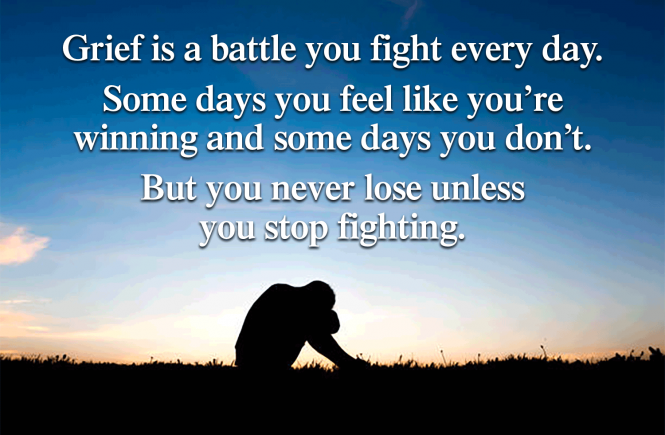
Grief will always win. Grief can’t be beaten. Grief can’t be overcome. The best I’ve found is that you can try to tame it, to turn it into a manageable beast which only sometimes gets the best of you. You can tame it so the scars it leaves become smaller and you’re not afraid to step in the ring with it because you know it won’t kill you. But at the same time, you don’t want to because you know how much it can hurt. But you know you’ll come out of it in the end.
Others may fully disagree and tell you that you can beat your grief. I think you simply learn to coexist with it. If it was beatable grieving parents would do whatever it took to win and never deal with it again. The reality is it will always be there. Grief is a formidable adversary. No matter how many times you knock it down, it always gets back up. But I can’t throw in the towel. I just have to step back in the ring and take my beating with the hopes that I can protect myself enough to come out battered but not broken each time grief and I come face to face.
For me, I’m a fighter and I’ll keep battling. But there are always those times that I lose the battle. Today is a day I feel like I’m losing the battle. If you see me looking beaten and broken, it’s most likely because on that day I am.
Holidays are often taken for granted by many of us, myself included. It’s the time of year we come together to spend time with our family, cook ridiculously large amounts of food, give each other unneeded gifts and just generally step away from what is our normal day-to-day activities. For many of us however, the holidays are far from the “hap-happiest season of all”.
Thanksgiving
A bountiful harvest, an overfed stomach and giving thanks for the blessings which have been bestowed upon us. Thanksgiving has always been one of my personal favorites, partially because of all the food, but also because it’s just a day to spend with family. A day to enjoy our time together without all the stress and financial burden that comes with Christmas.
Thanksgiving is supposed to be all about realizing our blessings and being thankful for each and every one of them. While there are many things to be thankful for, the loss of a child (and this year the added loss of a beloved grandmother) made it difficult at times to remain focused on the good things.
Christmas
Last year was our first Christmas without Cassie. It was extremely difficult to say the least. For years now every Christmas started out the same – Cassie running into our bedroom before the sun comes up while yelling “wake up it’s Christmas!” To say she loved Christmas would be an understatement.
That first time in many years of waking up without her voice on Christmas morning immediately let us know Christmas would never be the same. We of course had a good time with the rest of the kids, loved watching them get excited about opening their gifts and relished our time spent as a family. A big, loud, overpowering part of our family was gone though… and this year will be no different.
Holiday Struggles
The time leading up to Christmas has been a true struggle this year. Keeping my sanity and trying to stay positive is a battle I lose some days. I’ve had several people over the last couple of weeks say ‘are you feeling alright, you look like you don’t feel well.’
The truth is I don’t feel alright and it obviously shows. I’m not “sick” per se, I’m just drained from fighting this constant battle to keep my head up. Grief is exhausting. It’s a daily battle which never ends and this time of year it’s like an extra few battalions have been sent to attack.
For those who have lost a child you fight this battle every day. You’re not looking for pity by any means and you’re not asking people to feel sorry for you. For those who know someone dealing with a significant loss like this, understand when you see your friend who looks like they’re not feeling well, it may be a hurt you fortunately will never understand. A sick stomach, a pounding headache and stiff joints would be a welcome relief from the overwhelming attacks of grief. Most days you feel like you’re making headway, like you’re at least holding your ground in the battle. Then the holidays roll around and you realize your defenses can only hold out so long.
Stay Focused
The only way to make it through is to keep your focus on the things you have been blessed with in life. Be thankful for the time you had with the loved one you lost. Be grateful for the other loved ones you still have here by your side. Cherish those memories which are now so precious. And most importantly, keep your focus on what’s truly meaningful… and I promise you it’s not the presents.
This Christmas take a moment to reflect on the true value of having your family. Spend some time simply enjoying the sounds of your children. Be thankful for their laughter, their happiness and even their arguing or mouthiness. These things are the gifts you can never replace, you cannot buy and you will cherish for the rest of your life.
I hope everyone has a wonderful Christmas and try your best to not let the holiday struggles become the focus of the season.
When your child dies a piece of who you were goes along with them. There are a lot of things that go along with the loss of a child besides just physically losing them. For example, you also lose all of the future events that will now never happen – the weddings, the grandkids, the family time and so on. You also lose a sense of security and safety for your entire family.
The following just touches on a couple of the areas a grieving parent experiences loss. Hopefully it will help others better understand some of the daily struggles a grieving parent faces. The struggles that seem like they wouldn’t be a struggle in normal life, and they wouldn’t. But life for a grieving parent is far from normal.
Personal Identity
One big challenge I’ve personally struggled with is losing myself. It’s a struggle and is very real with a significant loss like this – you lose part of yourself to grief… or at least I have. So many things about me have changed in this first year that I no longer am the same person I once was and I really miss me.
You may be asking what I mean by saying I’ve lost myself, and it’s not a simple thing to explain. It’s consumed every portion of my life, yet I can’t fully explain it to anyone either. I try to hide it, I try to keep it from being obvious but it’s not always possible to do so.
The first and most obvious thing is a simple question people are asked all the time – “How many kids do you have?” This is a common, societal question that now becomes a challenge every time it’s asked. You immediately run through in your head…
Do I say four since my daughter is no longer here?
Do I say five even though there are only four still here?
Do I say five but one passed away?
Each of these answers has its own set of problems. Saying four just doesn’t feel right, because it’s not true. Saying five doesn’t feel right either because one of them is missing. But being honest and saying four living and one has passed away takes a commitment. It’s a commitment of time, energy and emotion. Now you have to decide if the person asking the question is worth that commitment.
Social Identity
I’ve always enjoyed being around people, having a good time, joking, laughing and making others laugh. It’s a big part of who I was. But now it’s something I struggle with. I still feel that desire to go out with others and have a good time, but often that desire changes when the time actually comes.
I find myself conflicted between being who I was and and who I am now, not wanting to go around anyone sometimes. I still want to go have that fun and at the same time I just want to sit at home. I’m no longer who I once was. Being happy is work now – it takes energy, effort and concentration. So most of the time it’s much easier to put up the facade. But, the truth is even I’m not a fan of that. I wish things could be like they were. I wish my family could be whole again. I wish I could be who I was.
Growing up many of us heard the old saying “Real men don’t cry”, some of us may have even used it ourselves at different points. But the reality is there comes a point that even the strongest people need to cry even when it’s the last thing they want to do.
We describe strong people quite often as a “rock”, which is true. The problem with being the rock however is that rocks don’t bend, they don’t flex, they don’t waiver. Rocks stay strong until the day they break, then they crumble into a million pieces and can never be put back together again no matter how hard everyone tries.
Urging our young men to not cry because it’s “weak” is detrimental to their mental health and well-being as an adult. When something as life-changing as losing a child happens in your life you’re left with only a few choices – you can get angry and destroy things, including relationships and loved ones; you can attempt to self-medicate with drugs and alcohol, which only pushes the grief further down the road while also introducing new problems; you can breakdown and cry, even at the most inopportune moments; or you can choose to leave this world behind.
At some point the feelings and emotions will come out, you can’t control it. The key is to decide if you’re going to let them come out in a healthy way, even if it may be embarrassing, or if you are going to travel down an unhealthy path. Many people decide to choose one of the unhealthy options because “real men don’t cry”.
I’ve spent more time crying in the last 14 months since we lost Cassie than I probably have the entire rest of my life combined. I don’t do it by choice, believe me it’s the last thing I want to do. I cry out of necessity. I cry out of a complete loss of the ability to do anything else. Sometimes I’m alone at home or in the car, other times I’m sitting at my desk or in a group of people. It’s not a choice of when or where, sometimes it just hits you.
Another gentleman described it as looking both ways then stepping out and getting hit by a bus you couldn’t see. It’s one of the most accurate descriptions I’ve heard, because you have no control and you don’t see it coming. You don’t choose to get hit by the grief bus, but it hunts you down and runs you over anyhow. You can’t outrun it, at least not for a sustained period of time, and you can’t avoid it all the time. It will find you.
Instead of being a rock we should urge our loved ones to be an oak tree, that bends and sways when the storms hit. Sure they’ll sometimes lose a branch or a limb, but most of the time they still stand strong after the storm. We need to bury our roots deep so when the bad storms hit we don’t topple over, even though we will sustain damage.
Real men DO cry. I’ve watched it happen to men you would never expect to see breakdown. Men who come from professions and walks of life where they will be the strongest of the strong. I’ve done it myself more than I care to admit. Crying as a man doesn’t make you weak, it makes you human. It’s the natural response to the loss of someone you loved with all your being, someone who was integral to your life, someone you would have died for without thinking twice.
If you’re a Christian you are actually commanded to rejoice with those who are rejoicing and cry with those who are crying. It’s a way of showing empathy. It’s a way of showing solidarity. And most importantly it’s a way of showing support and understanding that they’re hurting.
Rejoice with them that do rejoice, and weep with them that weep.
Romans 12:15
As men it’s important to let our families, especially our sons and grandsons, see us cry sometimes. They need to know it’s ok. They need to know it doesn’t make them weak. They need to know when someone tells them “real men don’t cry”, they can tell that person to piss off.
We all know we’re not immortal. We do however have an understanding of how mortality is “supposed” to work. If we’re living a decent life, not involved in drugs, crime, dangerous lifestyles, etc… we are supposed to live to a ripe old age. We know some of us will come down with cancer, heart disease or some other health issue as we get older, but for the most part we should live a relatively long life.
As parents we all worry about our children in a “I’m worried because I love them but realistically I know nothing is really going to happen” kind of way. When you lose a child, the reality of mortality suddenly hits you. I’ve come to realize those “irrational” fears I had for the safety of my children weren’t all that irrational after all. Losing a child forces you to fully realize that none of us are promised another breath.
I’ve never been one to get stressed or anxious when the kids aren’t right where they’re supposed to be when they’re supposed to be. I’ve never been one to imagine these horrible scenarios that could happen to my children. Now that all happens to me on a regular basis unfortunately. And at the same time these fears run through my head, I also know no matter what I do there’s no way to truly protect them. I now know it’s completely out of my control, and that’s what scares me the most.
The other thing that has happened for me is the reality of my own mortality has become much more apparent. The things I might have once ignored are a little more pressing on my mind now.
These concerns are more important not because I didn’t care before if I lived or not, I’ve just been shown how quickly life can be taken away. I’ve never wanted to die, but I’ve never really worried about it either. I’ve just lived by the idea that when my time comes it will come and there’s nothing I can do about that so why worry?
Now, however, I’ve fully seen the impact the unexpected loss of a loved one has had on my family. Not only do I not want something to happen to me, I don’t want to put my family through another loss. I’m not sure the damage it would cause or the problems my family would have because of it.
I don’t want to die. But the primary reason isn’t because of me, it’s because of my family. I also have selfish reasons. There are still lots of things I want to do and experience in life. I want to watch my children all grow up. I want to continue to be able to tell them all how much I love them and how proud of them all I am. I want to see my grandchildren grow up knowing their grandfather loves them as well. But ultimately I don’t want them to go through another major loss.
The reality of mortality has made me fearful. I’m not afraid of what will happen to me, I know where I’m going. I’m afraid of what will happen to the ones left behind. When you watch your loved ones torn apart by loss, how can you not be afraid?
That’s the thing with grief – it opens your eyes to a part of the world you knew existed but never realized how awful it was. I never fully knew the pain and suffering my family and I have experienced in the last year. Now that I know what that pain is and how hard the grief is to go through, I’m afraid.
One year. Initially I wanted to say how much has changed in a year, but the reality is that it didn’t change in a year. These things changed in the blink of an eye. One minute I’m eating lunch and the next I’m riding in a patrol car to go tell my wife that our daughter was dead.
It didn’t take a year for things to change. It has taken a year, and will continue to take many more I’m sure, to fully realize all of the changes that have happened. But the change happened immediately.
The most obvious change of course is no longer being able to talk to our daughter. No longer hearing her laughter, her inappropriate jokes and even the things that would aggravate and anger you. No longer getting the text messages with questions about the basics of how to live life. No longer having her around for family times. Those changes were obvious immediately, but many were not.
It takes a little time for it to sink in that you are now starting your first year of no new memories. You will never have another holiday to remember. You will never have another birthday to remember. You will never have another special event to remember. The only memories you will ever have are the ones that were already made.
You don’t fully realize that immediately, it begins to hit as events happen. Then the guilt and regrets begin to overtake your thoughts. Did I spend enough time making those memories we now cherish? Why did I waste time on other things that now mean nothing? Was this event or that action really worth the time I wasted fighting about it?
These are some of the first changes that begin to mold your new life… the life you never wanted. You begin to notice other changes as well. I’m no longer the person I once was, in some ways positive in some ways not.
I’ve always enjoyed being around other people – laughing, joking, having a good time. Now there are times I really struggle with it. I realize I’m not as much fun as I used to be. I realize I’m a constant reminder to others of the horrible truths of what life can be for a parent. I am now the embodiment of every parents worst nightmare, a visual and real representation that their worst fears really can come true. When friends and family look at me, I know there is that little voice in their head reminding them that this nightmare is real and it could happen to them just as easily.
There is a big change in not only how I look at life, but in how others look at me. Again, some of these changes are positive and some are not. I struggle at times to put on the good face, to show what people want to see or at least what I want them to see. I try to show strength, to be the rock my family needs and to be an example to others that you CAN get through the worst times in life.
But the reality is it’s quite often a show, or at least I feel like it is. Those days when others often think I’m at my strongest are the days I’m struggling to leave the house. The times others see me as a rock are often the times I’m feeling my most broken. The fun, joking person I once was no longer exists. I try to still be that person and can sometimes pull it off for a while.
But the truth is it’s just not me anymore, and I hate that. I realize I’m not much fun to be around at times. Even when I put on a good face and have fun, that’s not the person I get to be when I’m alone – when I’m at my most vulnerable. Very few people see the new me in my entirety.
The strength and emotional stability I was once confident in, has now changed. At times I feel like I’m stronger than I ever imagined and other times I breakdown over the simplest things. I texted a friend the other day to say we wouldn’t be at church Wednesday night because Thursday was the anniversary of Cassie’s death so we were taking a night off. I finished typing the simple message and for some reason broke down, spending the rest of the evening drained and devastated. It’s the simple things that get you.
I feel more empathy and care towards others, yet at the same time I feel less empathy and care towards others. That statement may not make sense, but it’s one of the changes. I understand hurt better than I ever wanted to and I feel for others who are hurting. Yet because I do understand hurt on a new level, I have little empathy for those who are “hurt” by mundane things in life.
I value and cherish those who have been here for me in the worst time of my life, and at the same time I am well aware of the ones who weren’t. Whether friend or family, if you couldn’t be there at my side when I needed you most, don’t be surprised when you’re no longer someone I drop everything to help. It may sound selfish, and maybe it is, but it’s just part of the change that has happened.
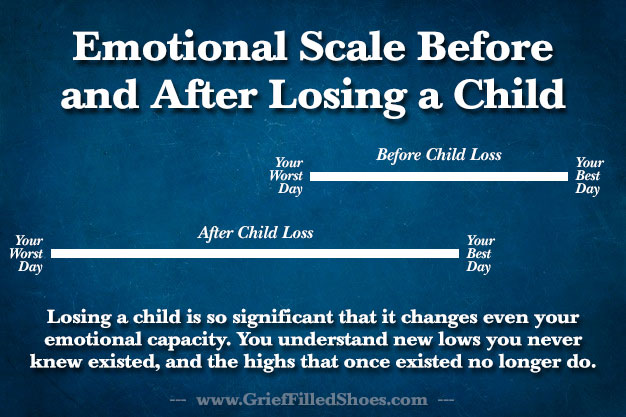
Another big change is joy. It’s just not there like it once was. The best I can explain it is like this, I’ve gone through life with emotions on a scale of 1-25 with 1 being the worst day of my life and 25 being the best day. A lot of people have an even narrower scale than that because the level 1 happened when my father committed suicide when I was a teenager. So my emotional scale had already hit a new low.
Now that entire scale has changed. For starters there is no longer a 25 on that scale. Even the best days are probably going to be around a 15 at most. The highs once experienced are no longer there, they’re tainted with the reality that even on the best days a piece of my heart and my family is gone.
The other change to that scale is that I’ve now realized ‘1’ was never really the low of where emotions can go. The new low is actually significantly lower than just a ‘1’. I’ve had loss throughout my life – a parent, grandparents, friends, family members… the list goes on. But the loss of a child is without comparison. It’s a level of pain I never even knew was possible. My entire outlook on what true pain is, changed in the blink of an eye. But like a lot of the other changes it has taken this entire year, and I’m sure many more, to truly begin to grasp what that new level of pain is.
In the blink of an eye my family was changed. Our whole life was turned upside down. Our future was damaged and our past was finalized. We will never experience Cassie’s wedding day, her first child, her first grandchild, see her become the amazing woman she was destined to be or any other multitude of things. As the other kids have children, none of them will ever know their aunt. They will never see how infectious her laugh was or get to experience all the trouble she would help them get into.
These changes all happened in the blink of an eye, yet it takes time for them to sink in. I will never again be the person I once was, for better or worse.
In the blink of an eye I not only lost my daughter, but I lost me.